
If you’re a Pakistani living and working abroad, your tax position is genuinely different from someone filing inside Pakistan — different documents, and often no wealth statement at all. 📋 Here’s exactly what applies for Tax Year 2026 (TY2026), covering 1 July 2025 to 30 June 2026. Filing opened on 15 July 2026, and the normal deadline is 30 September 2026.
Are You Actually a Non-Resident? 🛂
This matters more than people think — being outside Pakistan doesn’t automatically make you a non-resident for tax purposes. Under Section 82, you’re a Pakistani tax resident for the year if any of these apply:
- You were physically present in Pakistan for 183 days or more in the tax year
- You’re a Pakistani government employee posted abroad
- You’re a Pakistani citizen who was not present in any single other country for more than 182 days, or who isn’t a recognised tax resident of any other country (this rule was added in 2022 specifically to catch people who move between multiple countries without settling anywhere)
In plain terms: to be genuinely non-resident as a Pakistani citizen, you generally need to show you spent more than 182 days in one specific other country and that you’re a recognised tax resident there. If you split your year across several countries without settling in one, get your situation checked before assuming this checklist applies to you.
What Non-Residents Pay Tax On 🌍
If you are genuinely non-resident, Pakistan only taxes your Pakistan-source income — your foreign salary and foreign business income are outside its reach entirely. Pakistan-source income includes things like:
- 🏠 Rental income from property located in Pakistan
- 💼 Business income from operations or a permanent establishment in Pakistan
- 📈 Dividends from Pakistani companies, or capital gains on Pakistani assets
Good News: No Wealth Statement Required 🎉
Unlike every other segment in this series, Section 116‘s wealth statement requirement only applies to resident taxpayers. If you’re genuinely non-resident, you are not required to file a wealth statement even if you file a return for Pakistan-source income.
One caveat: FBR can still request a wealth statement from any individual by specific written notice, resident or not. The point is that it isn’t automatic for non-residents the way it is for everyone else in this series.
Your Document Checklist 📂
For everyone, before you start
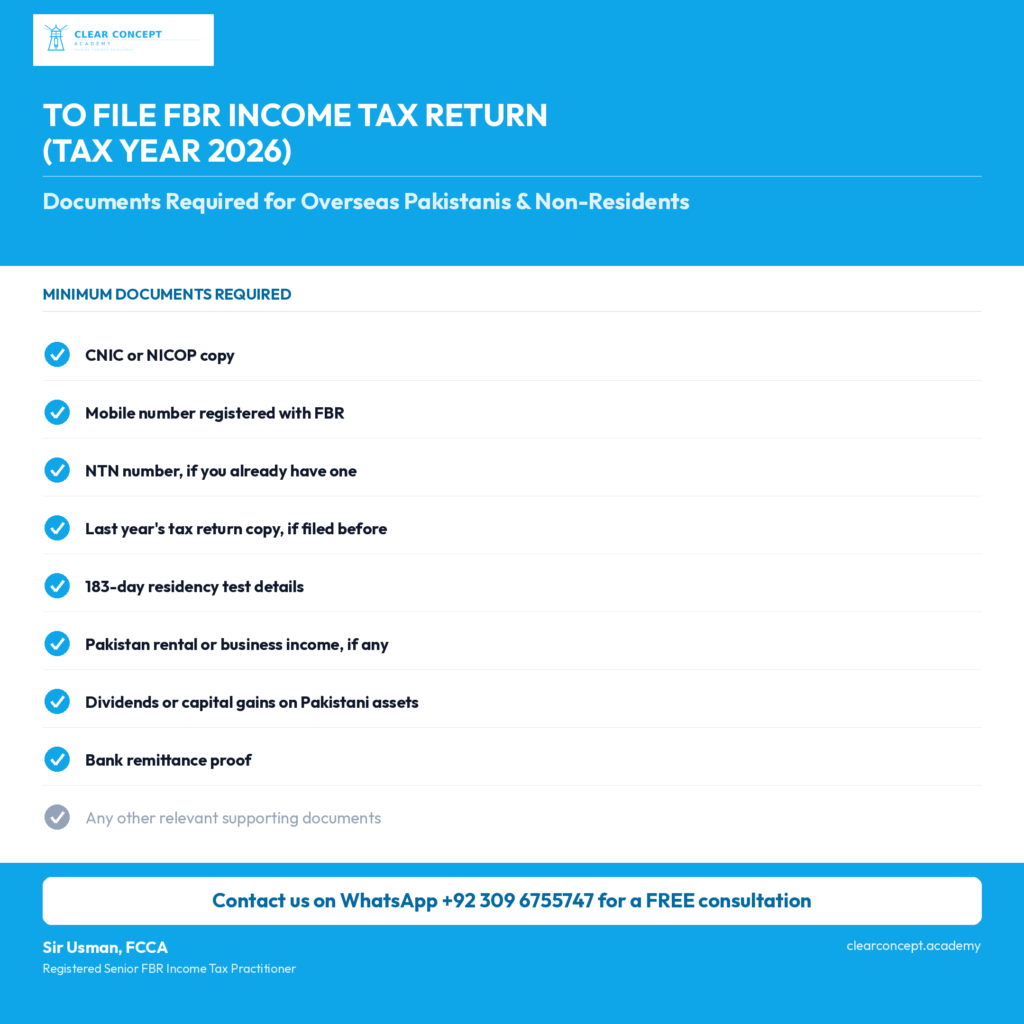
- ✅ CNIC or NICOP copy, front and back
- ✅ Mobile number registered with FBR
- ✅ NTN number, if you already have one
- ✅ Last year’s tax return copy, if you’ve filed before
To prove your non-resident status
- 🛂 Passport entry/exit stamps for the year, to show your day count in and out of Pakistan
- 📄 Overseas employment contract, Iqama, or work permit
- 🏛️ Foreign tax residency certificate, if you’re relying on being a recognised tax resident of another country
If you’re sending money home
- 💸 Remittance proof through a normal banking channel — up to Rs. 5 million per tax year is exempt from being questioned about its source (Section 111(4)); keep the bank’s encashment certificate
If you have any Pakistan-source income
- 🏠 Rent agreements and tenant withholding certificates, for any Pakistani property
- 💼 Business records, for any Pakistan-based business activity
- 📈 Dividend or capital gains statements, for any Pakistani investments
- 🏦 Bank profit certificates (Section 151), if you hold a Pakistani bank account — profit paid by a Pakistani bank is Pakistan-source income even for non-residents
Common Mistakes Overseas Pakistanis Make ⚠️
- Assuming "I live abroad" automatically means non-resident — the 2022 rule above can still catch you if you don’t settle in one country.
- Not keeping travel proof — without passport stamps, you can’t easily prove your day count if FBR asks.
- Remitting large amounts without using proper banking channels — informal transfers (hawala/hundi) don’t qualify for the Section 111(4) exemption, and lose you the protection entirely, not just above Rs. 5 million.
- Not filing at all, even though staying on the Active Taxpayer List gets you lower withholding rates on Pakistan transactions like property purchases.
Frequently Asked Questions
Do I have to file a return if I’m genuinely non-resident?
Only if you have Pakistan-source income. That said, many overseas Pakistanis file anyway to stay on the Active Taxpayer List, since being a filer significantly lowers withholding tax rates on property and other transactions back home.
Is the Rs. 5 million remittance limit a tax, or just a scrutiny exemption?
It’s a scrutiny exemption, not a tax-free ceiling in the sense of a cap on how much you can send. Above Rs. 5 million in a tax year, FBR can ask you to explain the source of the funds — it doesn’t automatically mean tax is owed.
What if I’m not sure whether I count as resident or non-resident this year?
Get it checked before you file. Getting this wrong in either direction — declaring worldwide income you didn’t need to, or leaving out income you should have declared — both cause real problems.
ClearConcept Academy offers FIA | ACCA | Tax Training & Consultancy Services, including full-service Tax Return Filing. Send your documents on WhatsApp: +92 309 6755747 or email info@clearconcept.academy and we’ll take it from there.
Sources: Income Tax Ordinance 2001 (as amended), Sections 82, 101, 111, 116; Finance Act 2022, Finance Act 2025. Filing dates confirmed via FBR IRIS portal, July 2026.
Pingback: Documents Required for Freelancers & Exporters to File Income Tax Return (TY2026) 📋 - Clear Concept Academy