
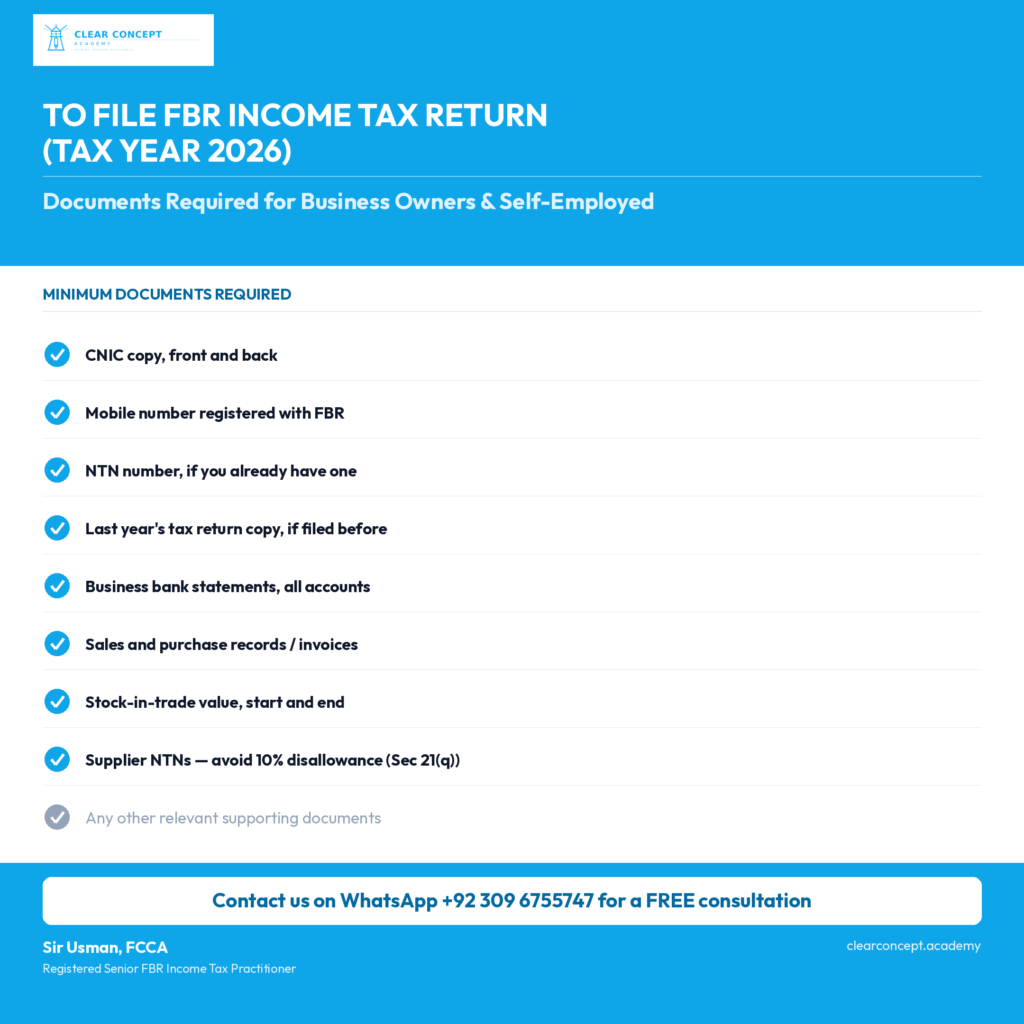
Running a business or working self-employed in Pakistan means a different set of documents than a salaried filer needs. 📋 Here’s exactly what to send for Tax Year 2026 (TY2026), covering 1 July 2025 to 30 June 2026. Filing opened on 15 July 2026, and the normal deadline is 30 September 2026.
Who This Covers 🏪
This checklist is for local business owners, retailers, traders, and self-employed professionals operating within Pakistan — your income is computed under the "Income from Business" head (Section 18, Income Tax Ordinance 2001). If you’re a freelancer or exporter earning in foreign currency, that’s a separate checklist — the documents differ.
Note: this is for individual sole proprietors. If you operate as a partnership or Association of Persons (AOP), the AOP itself must register and file its own return — the document list is different and covered separately.
Your Document Checklist 📂
For everyone, before you start
- ✅ CNIC copy, front and back
- ✅ Mobile number registered with FBR
- ✅ NTN number, if you already have one
- ✅ Last year’s tax return copy, if you’ve filed before
For your business, add these
- 🏦 Business bank account statement(s) for the year — every account you use for the business, and every business if you run more than one
- 🧾 Sales and purchase records or invoices for the year
- 📦 Stock-in-trade (inventory) value at the start and end of the year
- 📝 A simple list of business expenses — rent, utilities, salaries, and similar costs
- 📋 Rent agreement for your business premises, if you rent — helps substantiate the expense
- 🪪 NTN numbers of your major suppliers — missing this triggers a 10% disallowance on that spending (Section 21(q))
- 📄 Withholding tax certificates from clients who deducted tax on payments to you (Section 153)
- 🧾 CPR (Computerized Payment Receipt) for any tax you withheld and deposited on payments you made — rent, contractor fees, and similar — needed to claim those as expenses (Section 21(c))
For your Wealth Statement (required for every filer) 📑
Under Section 116, every resident individual filing a return must also submit a Wealth Statement and Wealth Reconciliation Statement. For a business owner, that includes:
- 🏭 Business fixed assets — machinery, equipment, shop fittings, and similar
- 📦 Closing stock-in-trade value, as an asset
- 🏠 Value and address of any property you own
- 🚗 Vehicle(s) you own, with approximate value
- 💵 Cash in hand, and value of gold or jewellery, if any
- 💳 Any loans or liabilities outstanding — business loans, credit cards, personal loans
- 🧾 A rough estimate of your personal/household expenses for the year
- 📄 Last year’s wealth statement, if available
Optional — only if these apply to you 💡
- 🏦 Withholding tax certificate on personal bank profit (Section 151)
- 🤝 Donation receipts, if you gave to an FBR-approved charitable institution (Section 61)
- 🏛️ Pension fund contribution receipt, if you contribute to an Approved Pension Fund / VPS (Section 63)
- 🕌 Zakat deduction certificate, if any Zakat was deducted from your account (Section 60)
- 🧾 Advance tax payment challans/CPRs, if your assessed business income was Rs. 1 million or more last year and you paid quarterly advance tax (Section 147)
Common Mistakes Business Owners Make ⚠️
- Paying large amounts in cash — a single transaction (or total under one account head) above Rs. 250,000 must go through a crossed cheque, bank transfer, or similar banking channel, or the expense is disallowed (Section 21(l)).
- Paying salaries above Rs. 32,000/month in cash — must go through the bank, or that salary expense is disallowed (Section 21(m), raised from Rs. 25,000 by the Finance Act 2023).
- Buying from suppliers without NTN records — 10% of that spending gets disallowed as a deduction, even if the purchase was genuine (Section 21(q)).
- Not keeping proof of tax you withheld — if you deducted withholding tax from a payment but can’t show it was deposited, that expense can be disallowed (Section 21(c)).
- Accepting more than Rs. 200,000 cash from a customer on a single invoice — this is a new rule from the Finance Act 2025. If payment isn’t through a bank or digital means, 50% of the expenditure claimed against that sale is disallowed (Section 21(s)).
Frequently Asked Questions
Do I need a separate NTN for my business?
No. As a sole proprietor, your personal NTN (same as your CNIC) covers your business income too — it’s just declared under a different income head.
Will minimum tax apply to me?
Only if your business turnover is Rs. 100 million or more in the tax year (Section 113). Most small business owners and self-employed individuals fall well below this.
What if I don’t keep formal expense records?
Send whatever you have — even a simple handwritten or Excel list. Incomplete records make your return harder to defend if questioned, but something is always better than nothing.
ClearConcept Academy offers FIA | ACCA | Tax Training & Consultancy Services, including full-service Tax Return Filing. Send your documents on WhatsApp: +92 309 6755747 or email info@clearconcept.academy and we’ll take it from there.
Sources: Income Tax Ordinance 2001 (as amended), Sections 18, 21, 60, 61, 63, 113, 116, 147, 151, 153; Finance Act 2025. Filing dates confirmed via FBR IRIS portal, July 2026.
Pingback: Never Filed Before? Documents You Need for Your First Income Tax Return (TY2026) 📋 - Clear Concept Academy
Pingback: Documents Required for Freelancers & Exporters to File Income Tax Return (TY2026) 📋 - Clear Concept Academy