
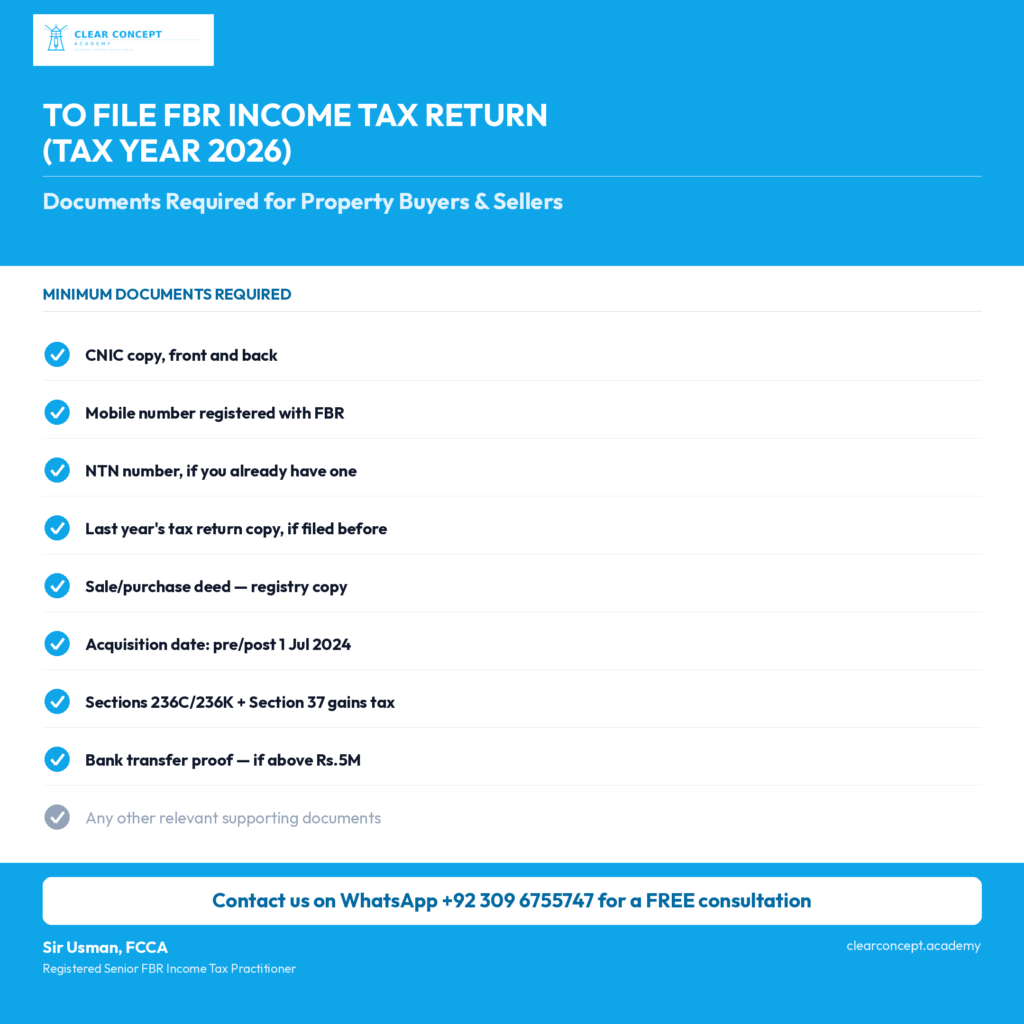
Buying or selling property in Pakistan involves two separate taxes, and mixing them up is the most common mistake people make. 📋 Here’s exactly what to send for Tax Year 2026 (TY2026), covering 1 July 2025 to 30 June 2026. Filing opened on 15 July 2026, and the normal deadline is 30 September 2026.
Two Separate Things: Transaction Tax vs Gain Tax 🏠
- Sections 236C (seller) and 236K (buyer) — advance tax collected at the time of the transaction, based on the property’s value, not your profit. Both sides pay something.
- Section 37 capital gains tax — tax on your actual profit, computed separately when you file your return. Only the seller has this.
Why Your Acquisition Date Matters So Much 📅
How your capital gain is taxed depends entirely on when you originally bought the property:
- 📆 Acquired on or before 30 June 2024: the rate depends on how long you held it — up to 15% for a quick flip, tapering down the longer you hold, down to 0% once you’ve held it long enough (roughly 2 years for flats, 4 years for houses, 6 years for open plots).
- 🆕 Acquired on or after 1 July 2024: holding period no longer matters. It’s a flat 15% if you’re on the Active Taxpayer List, or normal income-slab rates (with a 15% floor) if you’re not.
This is exactly why proving your original acquisition date is one of the most important things you can send us.
The Rs. 5 Million Cash Trap ⚠️
Under Section 75A, any property purchase above Rs. 5 million must go through a bank — crossed cheque, bank transfer, or digital means. Pay in cash instead, and you permanently lose the right to count that price as your cost when you eventually sell. Your taxable gain could end up far larger than your real profit.
Your Document Checklist 📂
For everyone, before you start
- ✅ CNIC copy, front and back
- ✅ Mobile number registered with FBR
- ✅ NTN number, if you already have one
- ✅ Last year’s tax return copy, if you’ve filed before
If you bought or sold property this year
- 📝 Sale/purchase deed (registry copy) for the transaction
- 🏦 Bank transfer proof of payment made or received — required if the value is above Rs. 5 million
- 📄 Section 236C/236K withholding tax certificate or challan from the transaction
If you’re the seller
- 📜 Your original purchase deed, from when you first acquired the property — this proves your acquisition date and your cost
- 🔨 Receipts for any renovation or improvement costs, if you want to add them to your cost base and reduce your taxable gain
For your Wealth Statement (required for every filer) 📑
Under Section 116, every resident individual filing a return must also submit a Wealth Statement and Wealth Reconciliation Statement, updated to reflect the property bought or sold. Also include:
- 🏠 Value and address of any property you still own
- 🚗 Vehicle(s) you own, with approximate value
- 💵 Cash in hand, and value of gold or jewellery, if any
- 💳 Any loans or liabilities outstanding
- 🧾 A rough estimate of your personal/household expenses for the year
- 📄 Last year’s wealth statement, if available
Optional — only if these apply to you 💡
- 🏦 Withholding tax certificate on personal bank profit (Section 151)
- 🤝 Donation receipts, if you gave to an FBR-approved charitable institution (Section 61)
- 🏛️ Pension fund contribution receipt, if you contribute to an Approved Pension Fund / VPS (Section 63)
- 🕌 Zakat deduction certificate, if any Zakat was deducted from your account (Section 60)
Common Mistakes Property Buyers & Sellers Make ⚠️
- Paying cash for property over Rs. 5 million — you lose the ability to count that amount as your cost, which can massively inflate your taxable gain later.
- Losing the original purchase deed — without it, you can’t prove your acquisition date or your real cost, and end up taxed on the worst-case assumption.
- Confusing 236C/236K with your actual tax bill — those are advance payments based on property value, not your final capital gains liability.
- Not being on the ATL — it affects both your withholding rate at the transaction and, for property acquired after July 2024, your actual capital gains rate.
Frequently Asked Questions
Do I owe capital gains tax even if I don’t sell for years?
No. Capital gains tax only applies when you actually dispose of the property. Holding it isn’t a taxable event by itself.
What if I’ve lost my original purchase deed?
Try to get a certified copy from the relevant registrar’s office before you file — it matters more than almost any other document in this checklist.
Does the Rs. 5 million cash rule apply to buying, selling, or both?
It applies to the purchase side under Section 75A. But since it affects your future cost basis, it matters to you as a seller too, if that’s how you originally bought the property.
ClearConcept Academy offers FIA | ACCA | Tax Training & Consultancy Services, including full-service Tax Return Filing. Send your documents on WhatsApp: +92 309 6755747 or email info@clearconcept.academy and we’ll take it from there.
Sources: Income Tax Ordinance 2001 (as amended), Sections 37, 60, 61, 63, 75A, 76, 116, 236C, 236K; First Schedule Part I Division VIII and Part IV Divisions X & XVIII; Finance Act 2024, Finance Act 2025. Filing dates confirmed via FBR IRIS portal, July 2026.